Military Food Nutrition Update
By Zen Honeycutt, Kendall Mackintosh, and Triada World science advisors
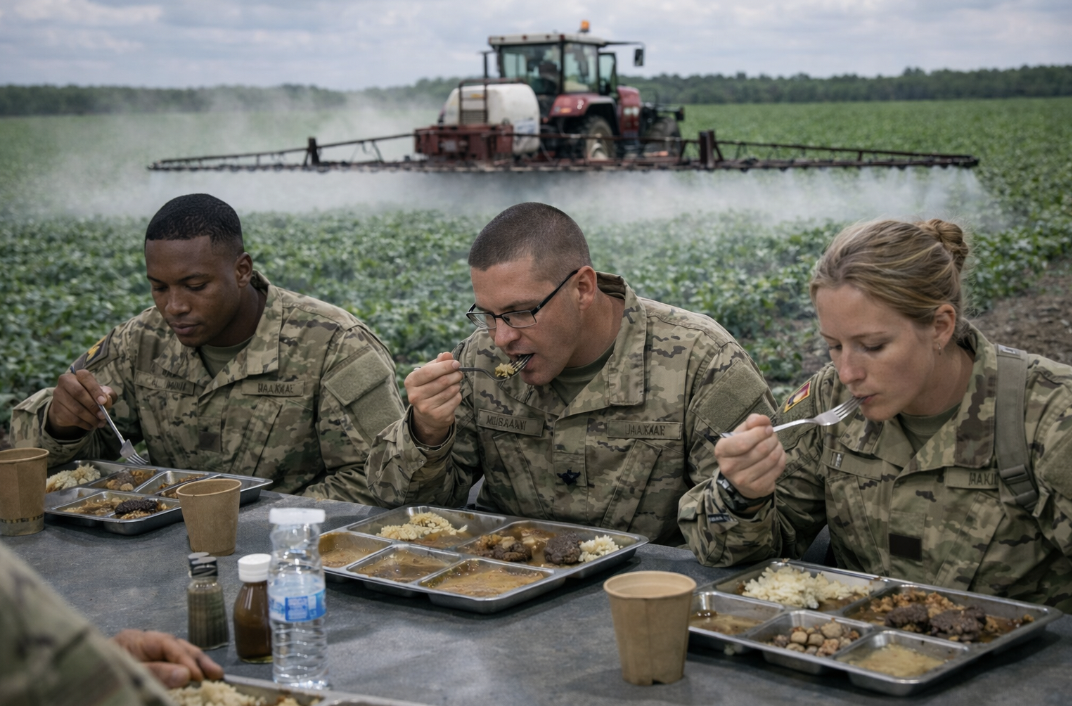 On February 4, 2026, Moms Across America (MAA) issued our Military Food Test Results exclusively to ABC. After the broadcast, a nutritionist identified a conversion error in the analysis, revealing that the information we released was inaccurate. We apologize to ABC, the public, and the military for this error. Corrections to our methodology have been made, and the following updated analysis has been reviewed by multiple nutritionists and scientists and is accurate.
Moms Across America is fueled by the dedication of mothers who have shared anecdotal experiences for over 13 years regarding our own children’s health issues. Their experiences, such as the vast improvements in their children's health when they eat organic food and avoid toxins, are valid and essential for understanding how we can all improve our own health. However, it is critical to us that all of our work, our foundation, is also backed by high-quality, independent science.
The science gathered through nutritional testing of military food raises additional questions that must be addressed for military health and public safety, and as a matter of national homeland security.
Summary
The dataset shows a clear, repeated pattern across all menus. Military entrées contain mineral levels that are consistently and often dramatically higher than United States Department of Agriculture (USDA) baselines for comparable foods. The pattern is not random; it reflects systematic mineral-synthetic fortification and, in some cases, immense over‑fortification, particularly for sodium, manganese, calcium, iron, and copper.
- Of the available data on 9-10 minerals assessed across 10 samples, the military’s food nutrition was up to 25% higher than USDA-comparable standards.
- The military food samples were 40-60% higher in nutritional value than school lunches.
- Using synthetic fortification to address low nutrient density in school lunches is not advisable, as it can pose health risks.
- The need for any fortification highlights nutrient deficiencies in our food, perhaps due to agrochemical farming and the presence of glyphosate, a nutrient chelator found in, on average, 95%-100% of non-organic foods tested by MAA and up to 20% of organic food due to contamination.
- Minerals such as iron, sodium, calcium, manganese, and copper were at exceptionally high levels in many of the samples tested.
Link to laboratory report
Read moreFarm Action and MAHA Leaders React to USDA’s Regenerative Agriculture Initiative
For Immediate Release
December 10, 2025
Media Contacts:
Trevor Fitzgibbon, 704-775-0487, [email protected]
Farm Action issued the following response to an announcement from the U.S. Department of Agriculture (USDA) on a $700M investment into regenerative agriculture.
This statement can be attributed to Angela Huffman, Farm Action’s president and co-founder:
“Farm Action welcomes today’s announcement that the administration will direct hundreds of millions of dollars toward regenerative agriculture. Regenerative agriculture is not only better for the land and public health, but it also creates a path to rebuilding farmer profitability and reducing dependency on costly chemicals and other inputs controlled by a few giant companies.
Done right, this investment will help farmers lower their input costs, break free from the export-driven commodity overproduction treadmill, and move toward healthier, more resilient, and more profitable farming systems. This initiative reflects the priorities Farm Action has long championed and repeatedly urged the government to adopt.
If the Trump administration wants this initiative to succeed, USDA must make sure the Natural Resources Conservation Service—after significant funding cuts—has enough staff to get these dollars out quickly and fairly, reaching farmers across America, not just the largest operations by default.
We cannot allow a repeat of the Climate-Smart Commodities program, where projects involving multinational corporations like JBS and Tyson Foods received the lion’s share of program dollars, fueling further consolidation.”
This announcement from USDA and HHS mirrors calls Farm Action made in both its policy recommendations for the Make America Healthy Again Commission and, more recently, a letter it co-led to USDA signed by a coalition of 120 farmers and MAHA leaders calling for investment in regenerative agriculture.
- Angela Huffman, Farm Action’s president and co-founder
While we are thrilled that the Trump administration is investing in supporting farmers to transition to regenerative agriculture, it is imperative for successful implementation that the farmers have training, meaning an investment in staffing at the Natural Resources Conservation Service.
It is also crucial to Make America Healthy Again that farming practices shift to non-toxic inputs. Reducing our exposure to toxic chemicals is how we achieve MAHA, and how Trump leaves a legacy of healthier children and grandchildren.
- Zen Honeycutt, Founding Executive Director,Moms Across America and the Moms Across America Movement
Today’s announcement by the USDA is significant for its call for support for regenerative agriculture and its promise to fund better soil health practices, but these promises fall short in light of the massive layoffs at the NRCS earlier this year.
If the Trump administration is serious about helping America’s farmers transition to more environmentally friendly farming practices, it needs to recognize the importance of well-trained NRCS staff in helping farmers achieve those goals in real-world situations.
- DavidMurphy, founder of United We Eat, former top fundraiser for RFK, Jr’s presidential campaign
I am grateful that USDA Secretary Rollins is elevating and investing in regenerative agriculture. The Regenerative Agriculture Initiative is a significant step in the right direction.
However, this same year, the USDA cut more than a billion dollars from local and regional food programs—such as farm-to-school and farm-to-food-bank—that provide critical markets for regenerative farmers. Clearly, there is still a long way to go.
If policymakers are serious about transitioning American agriculture toward farmer prosperity and soil regeneration, they should restore the thousands of recently eliminated NRCS staff positions that are essential to supporting farmers through this transition. USDA should also reinstate the many programs that have been cut this year, as outlined in the letter from MAHA leaders and MAHA-aligned farmers.
- Charles Eisenstein, author and former speechwriter for Secretary Robert F. Kennedy, Jr’s presidential campaign
USDA Says, "Not Our Job!" To Regulating GMOS
Gifting Private Corporations with Giant GMO Free-For-All
 According to the FDA, the “USDA's Animal and Plant Health Inspection Service (APHIS) oversees the agricultural and environmental safety of planting and field testing of genetically engineered plants.”
Apparently, according to the recent release of the USDA’s branch APHIS final ruling on the Movement of Certain Genetically Engineered Organisms - 7 CFR Parts 330, 340, and 372, they disagree. The statement “We do not agree,” appears 21 times in the 49 page document, with nearly all of the disagreement directed towards the comments opposing the ruling which essentially allows GMO companies to self determine if their products require regulation. There were 6,150 comments filed; only 25 expressed some support of the ruling.
The APHIS ruling is very clear that their intention is to reduce the GMO regulations, support the market, innovation and lower costs for the GMO developers. Not a word about health or safety.
Here are 13 points that should be of great concern to anyone - consumer or international trade partners alike- who would expect our food to be healthy and safe in America:
Read moreMoms Across America Asks USDA to Regulate GMOs, Protect Life and US Economy
THIS IS OUR 300th Article!
Wow! Thanks for being with us on this incredible journey!
Comment to USDA Regarding GMO Regulation
By Zen Honeycutt, Moms Across America
August 2, 2019

The words of this comment are partially attributed to the Center for Food Safety, and partially to Moms Across America (in italics).
The new GMO regulations threaten America and beyond in the following ways
Health:
Our federal health care spending topped 3.5 trillion in 2018. Food is the most impactful factor of our health. American food is toxic, and it is making us sick. It could make us bankrupt.
Read moreREAL GMO Labels Proposed to USDA
This is our last chance for GMO Labeling.
Do you want GMOs to be labeled with happy, sunny, smiley faces?
This is what the USDA, due to pressure from big GMO companies no doubt, are proposing.

Do they remind you of something? Perhaps the organic symbols? If you have ever traveled to Europe, you will see these logos below in almost every shop--"BIO" in Europe stand for Organic. And yet the GMO industry wants to label GMOs with BE that stands for "BIO-Engineered Food." The GMO industry is trying to Co-Opt the organic industry!